Imagine stepping away from the world for a few days, leaving all distractions behind, and dedicating every moment solely to Allah. This is the essence of Iʿtikāf, a unique spiritual retreat in Islam that rejuvenates the soul, strengthens faith, and multiplies rewards—especially during the last ten days of Ramadan.
During Iʿtikāf, Muslims seclude themselves in a masjid to focus on prayer, Quran recitation, dhikr, and reflection, detaching from worldly matters to draw closer to Allah. Both men and women may perform Iʿtikāf, with women requiring husband or guardian permission.
In this article, we will discuss everything about Itikaf in Islam to help you understand what Itikaf is and all details related to it in Islamic Shari’ah.
What is Itikaf meaning?
Itikaf (اعتكاف) is an Arabic term that refers to seclusion and devoted attachment to a place or act for a specific period of time.
Itikaf Meaning in Arabic
In Arabic, Itikaf comes from the root عكف, which means to devote oneself to something and remain attached to it in a manner of reverence.
(Al-Rāghib al-Aṣfahānī – Al-Mufradāt)
Itikaf Meaning in Shariʿah
In Islamic Shariah, Itikaf is an act of worship that involves making a sincere intention (niyyah) and secluding oneself in a masjid for a defined period—whether long or short—while devoting oneself to acts of ʿibādah, such as prayer, Quran recitation, dhikr, and supplication.
Read also:
What is Itikaf in Ramadan?
Itikaf in Ramadan follows the same ruling and conditions as general Itikaf—making a sincere intention (niyyah) and remaining in a masjid for the purpose of worship—but it is specifically observed during the month of Ramadan.
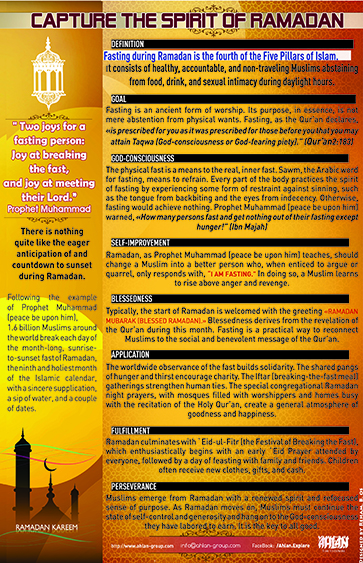
Performing Itikaf in Ramadan is a Sunnah Mu’akkadah (confirmed Sunnah) of the Prophet Muhammad ﷺ, particularly during the last ten days and nights of Ramadan, as he consistently observed it in pursuit of Laylat al-Qadr and increased devotion to Allah.
Abu Hurairah (RAA) reported: The Prophet (PBUH) used to observe I’tikaf every year (during Ramadan) for ten days; in the year in which he passed away, he observed I’tikaf for twenty days.
Scholars agreed that one enters the Masjid before Fajr of the twentieth of Ramadan and exits after Maghrib of the last day of Ramadan or even better after Fajr or Eid Salaht.
Related Articles about Ramadan:
Is Itikaf compulsory in Islam?
Itikaf is generally not compulsory in Islam. However, its ruling varies depending on the intention and circumstance. Scholars classify Itikaf under three main rulings:
- Sunnah Mu’akkadah (confirmed Sunnah):
This applies especially to Itikaf during the last ten days and nights of Ramadan, following the consistent practice of the Prophet ﷺ. - Mustahabb (recommended voluntary act):
Itikaf may be performed voluntarily at other times as a form of devotion and closeness to Allah. - Wājib (obligatory) due to Nadhr (vow):
If a person makes a vow (nadhr) to perform Itikaf, then it becomes obligatory to fulfill it exactly as vowed.
Evidence of Itikaf from the Sunnah (Hadith)
The practice of Itikaf is firmly established in the Sunnah. ʿĀ’ishah (RAA) narrated:
“The Messenger of Allah ﷺ used to perform Itikaf during the last ten days of Ramadan until he passed away. Then his wives used to perform Itikaf after his death.”
(Al-Bukhārī and Muslim)
This hadith clearly demonstrates that Itikaf in the last ten days of Ramadan is a confirmed Sunnah.
Evidence of Itikaf from the Quran
The Quran explicitly mentions Itikaf in more than one verse, confirming its legitimacy and importance:
Allah ﷻ says:
“And We entrusted Abraham and Ishmael to purify My House for those who circle it, who perform Itikaf in it, and who bow and prostrate themselves ˹in prayer˺.”
He ﷻ also says:
“Do not be intimate with your spouses while you are performing Itikaf in the mosques.”
These verses confirm that Itikaf is a recognized act of worship in Islam with defined rulings and boundaries.
What are the benefits and importance of Itikaf?
Itikaf is a great prescribed act of obedience in Islam. Like all obligatory and voluntary acts of worship, its ultimate purpose is to please Allah, seek His reward, and draw the believer closer to his Creator. Through seclusion in the masjid, the heart is purified, intentions are refined, and devotion is strengthened.
Among the most important benefits of Itikaf are:
- Strengthening the spiritual connection with Allah
- Achieving sincerity (ikhlāṣ) in worship
- Full dedication to ʿibādah and obedience
- Training the soul and struggling against personal desires
- Distancing oneself from distractions and worldly attachments
- Increasing acts of worship that purify the soul
- Developing spiritual resilience to face the trials and temptations of life
The True Essence of Itikaf
Ibn al-Qayyim (رحمه الله) explained the true spirit and ultimate objective of Itikaf in profound words:
“The essence of Itikaf is the heart’s complete devotion to Allah Most High, gathering all its concerns around Him alone, secluding oneself with Him, and cutting off excessive attachment to creation in order to be fully occupied with Him alone. …
Thus, real happiness with Allah replaces happiness with people. Through this, the servant prepares himself for happiness with Allah in the loneliness of the grave, when there will be no companion and no source of joy other than Him. This is the greatest objective of Itikaf.”
(Ibn al-Qayyim, Zād al-Maʿād)
Are There Authentic Hadiths on the Virtues of Itikaf?
There are no ṣaḥīḥ (authentic) or ḥasan (sound) hadiths that specifically detail the virtues or rewards of Itikaf.
Imam Abu Dawud reported:
“I said to Ahmad (i.e., Imam Ahmad ibn Hanbal): Do you know anything about the virtue of Itikaf?
He said: No, except something weak.”
Weak Hadiths and the Overall Status of Itikaf
That said, several weak hadiths mention the virtues of Itikaf. Although none can be relied upon individually, their collective meaning supports the importance of Itikaf and indicates that it is a highly rewarded act of worship, especially when practiced according to the Sunnah.
Above all, the Quran, the established practice of the Prophet ﷺ, and the objectives of Islamic worship are sufficient to affirm the great spiritual value of Itikaf.
Read:
Who may do Itikaf?
Any Muslim may perform Itikaf provided that the following conditions are met:
- The person is a Muslim adult
- He or she is free from major ritual impurity, such as:
- Janābah (post-sexual impurity)
- Menstruation
- Postpartum bleeding (nifās)
- Janābah (post-sexual impurity)
- The intention (niyyah) is to devote time exclusively to worship
- Itikaf is performed inside a masjid
It is important to note that a Muslim woman requires her husband’s permission to perform Itikaf.
Read more:
How to do Itikaf?
To perform Itikaf, a Muslim begins by making a sincere intention (niyyah) to devote a specific period of time to worship for the sake of Allah. After that, one chooses a suitable place inside a masjid to remain in during the period of Itikaf.
The place selected should not interfere with congregational prayers or cause inconvenience to other worshippers.
Where Should Itikaf Be Performed?
Most scholars hold the opinion that Itikaf should be performed in a masjid where:
- The five daily prayers are established in congregation
- Jumuʿah (Friday prayer) is also performed in congregation
This ensures continuity of worship without the need to leave the masjid unnecessarily.
Length of Itikaf
The duration of Itikaf depends entirely on one’s intention:
- It may last for the duration of one prayer
- A night
- A day
- Or several days and nights
There is no minimum or maximum time limit for voluntary Itikaf; it is determined by the worshipper’s intention and ability.
What are the Rules of Itikaf?
During Itikaf, a Muslim (called a Muʿtakif) must observe specific rules that define what is permitted and what is prohibited, according to Islamic Shari‘ah. These rules help preserve the spiritual purpose of Itikaf while allowing necessary human needs.
Below are the main do’s and don’ts of Itikaf.
What Can You Do During Itikaf?
A Muʿtakif is permitted to engage in many necessary and beneficial activities, including:
- Performing all congregational prayers (Jamāʿah), including Jumuʿah
- Making abundant duʿā’ (supplication)
- Eating, drinking, sleeping, and resting
- Going to the bathroom, performing ghusl (major purification), or leaving briefly for urgent necessities
- Providing food and drink to Muslims in Itikaf (this is highly rewarded)
A Muʿtakif should strive to fill his time with acts of worship that please Allah, such as:
- Ṣalāh
- Quran recitation
- Dhikr (remembrance of Allah)
- Tawbah (repentance)
- Learning and studying Islamic knowledge (Sharīʿah, fiqh, ʿaqīdah, Islamic history, etc.)
Other permissible actions include:
- Performing Janāzah prayer and following the funeral to burial
- Making, witnessing, or concluding contracts, including:
- Marriage contracts
- Partnerships
- Buying and selling
- Marriage contracts
- Visiting a sick person briefly; not going into the house unnecessarily.
- It is okay and rewarded by Allah to fast during Itikaf, but if one chooses not to fast, it is not sinful.
Interaction with One’s Wife During Itikaf
A Muʿtakif may interact with his wife in lawful, non-intimate matters, such as conversation or assistance.
ʿUrwah reported from ʿĀ’ishah (RAA):
“The Messenger of Allah ﷺ inclined his head toward me while he was in the masjid, and I combed his hair while I was menstruating.”
(Muslim)
He may also:
- Escort his wife home after she brings him food
- Return to the masjid afterward
Narrated ʿAli ibn al-Ḥusayn:
Ṣafiyyah (RAA), the wife of the Prophet ﷺ, visited him while he was in Itikaf during the last ten days of Ramadan. After speaking for a while, she stood to leave, and the Prophet ﷺ accompanied her.
(Al-Bukhārī)
What You Cannot Do During Itikaf
Some actions invalidate Itikaf completely, so they must be strictly avoided:
- Leaving the masjid without a valid Sharīʿah-approved reason
- Apostasy (riddah)—since Itikaf requires Islam
- Loss of mental capacity
- Major ritual impurity, including: Sexual intercourse, masturbation, menses and postpartum bleeding time
- Quarreling, fighting, or disturbing others in the masjid or those in Itikaf
Such behaviors contradict the purpose of Itikaf, which is serenity, devotion, and closeness to Allah.
Itikaf Rules for Females
Women follow the same general rules of Itikaf as men, with some specific guidelines to ensure modesty, privacy, and proper observance:
- A Muslim woman must observe hijab and should not be among men in the masjid.
- She must not be in a state of major impurity (janābah, menstruation, or postpartum bleeding). If her impurity begins during Itikaf, her Itikaf ends immediately.
- She requires the permission of her husband or guardian to perform Itikaf.
Can a woman talk to her husband during Itikaf?
Yes, she may converse with her husband in lawful matters, as long as it does not distract from her worship.
Can Itikaf be done at home by men or women?
No. Most scholars agree that Itikaf must be performed in a masjid for validity. This is based on the Quranic mention of Itikaf in the masjid:
An-Nawawī declared:
“Itikaf is not valid for men or women except in the masjid. It is not valid in a masjid at a woman’s house or a man’s house.”
Related Articles about Ramadan:
Is it compulsory to make up for missed Itikaf?
It is compulsory to make up missed Itikaf only if it was a vowed Itikaf. We have evidence in this hadith that vowed Itikaf should be fulfilled, as it is a kind where a Muslim obliges himself to do it as an obedience for his Lord. In it, the Messenger PBUH commanded Umar RAA to make up a missed Itikaf and Sawm that he vowed to fulfil.
Narrated Abdullah ibn Umar: Umar (may Allah be pleased with him) took a vow in the pre-Islamic days to spend a night or a day in devotion near the Ka’bah (in the sacred mosque). He asked the Prophet (PBUH) about it. He said: Observe i’tikaf (i.e., spend a night or a day near the Ka’bah) and fast. [Bukhari & Muslim reported]
Seclusion in Islam: A Balanced Perspective
While Islam encourages Muslims to actively engage with society and be a source of blessing for those around them, it also recognizes the importance of spiritual rejuvenation. Itikaf, especially recommended during the last ten days of Ramadan, provides a period of seclusion for the soul to recharge through worship, reflection, and closeness to Allah.
Conclusion
To conclude, the article answers the question of “what is Itikaf,” highlighting that Itikaf is a profound act of worship in Islam, performed in complete devotion and submission to Allah. Like all acts of worship, its purpose is to please Allah, earn His reward, and draw the believer closer to Him. It is a spiritual retreat that strengthens faith, purifies the heart, and increases mindfulness of Allah in daily life.
Itikaf is best done during the Last ten days of Ramadan, following the confirmed Sunnah of the Messenger PBUH, when rewards are multiplied for all good deeds. Muslim women can do Itikaf as well with the permission of the husband and even may be at home according to Muslim scholars.
Key Points About Itikaf:
- Meaning: Seclusion with devotion to Allah for worship and reflection.
- Place: Must be performed in a masjid.
- Duration: Flexible, based on intention; from one prayer to several days or nights.
- Do’s: Pray, recite Quran, make dhikr, seek forgiveness, learn Islamic knowledge, and attend Janāzah prayers.
- Don’ts: Leaving the masjid without reason, major impurity, quarrels, or disturbances invalidate Itikaf.
Now it’s your turn to experience the unique peace of seclusion, away from life’s daily noise, and see how it deepens your spirituality. If you have any questions, our team is ready to help—just send us a WhatsApp message anytime!